The PerfectCLEAN Post
Hospital Curtain Infection Prevention CPULL
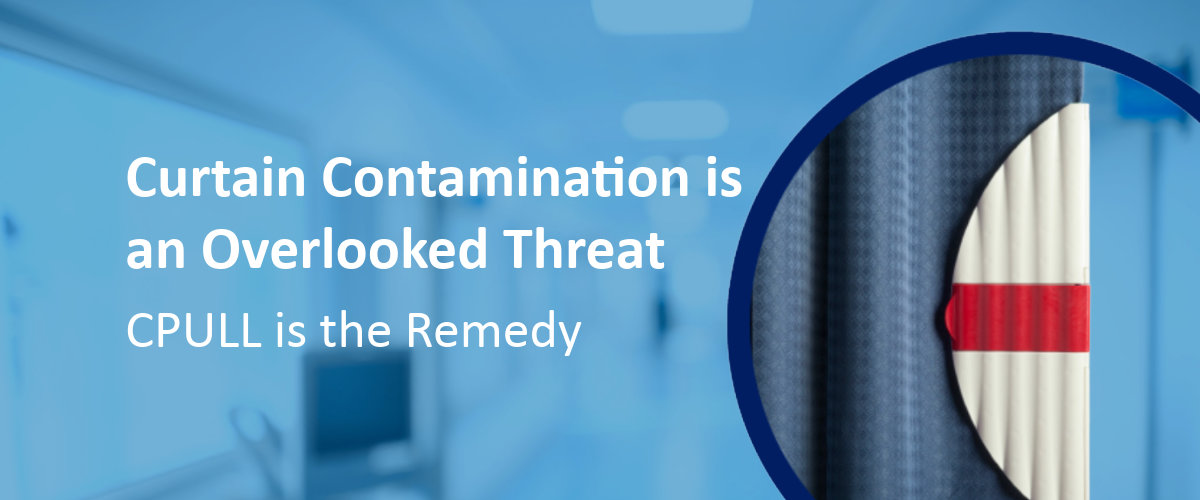
Pathogens move through healthcare environments in ways that aren’t always obvious. High-touch surfaces—bed rails, call buttons, door handles—have long been prioritized in daily cleaning and disinfection protocols.
But one critical surface still puts patients at risk – the patient privacy curtain.
Growing clinical evidence proves that privacy curtains quickly become contaminated with numerous pathogens and remain contaminated despite routine environmental cleaning practices. Ideally, the cubicle curtain should be changed out upon a patients discharge. However, based on the time, labor, manpower and cost, this is not economically feasible. This can undermine even the most diligent infection prevention program.
THE PROBLEM: Privacy Curtains Become Contaminated Faster Than You Realize
A longitudinal study published in the American Journal of Infection Control observed freshly laundered privacy curtains in a burns/plastic unit over 21 days.
The findings were staggering:
- By Day 3, curtains near patient beds showed a rapid rise in microbial contamination compared to controls.
- By Day 10–14, the majority of curtains tested positive for MRSA, despite patients in the room not being MRSA-positive.
- By Day 21, nearly all sampled curtains exceeded recommended surface hygiene thresholds, with contamination peaking at a mean of 5.11 CFU/cm².
In short: contamination doesn’t take weeks or months. It takes days.
These findings align with earlier research showing that 42% of cubicle curtains are contaminated with VRE, 22% with MRSA, and 4% with C. diff—all of which are well-documented sources of preventable healthcare-associated infections (pHAIs).
Why Are Curtains a High-Risk Vector?
Curtains check every box for problem surfaces:
- They’re touched constantly by clinicians, patients, and visitors.
- They are rarely cleaned at patient discharge.
- They often hang for months or longer between laundering or replacement.
- People tend to move them without performing hand hygiene.
The AJIC study confirms what infection prevention teams already suspect: every time a curtain is pulled, microbial load increases, creating a consistent pathway for hand-to-surface transfer.
Why Existing Curtain Protocols Aren’t Enough
A recent article in Infection Control Today highlights a broader systemic issue: most healthcare facilities maintain outdated cubicle curtain protocols, treating them as soft furnishings rather than high-touch surfaces requiring routine attention.
Curtains may ONLY be changed under four conditions:
- They are visibly soiled.
- They are stained or torn.
- A patient on isolation precautions is discharged.
- A routine quarterly or monthly schedule flags them for replacement.
But as the AJIC data makes clear, contamination occurs far earlier and far more consistently than these schedules account for. Infection preventionists are left with a dilemma: curtain laundering upon patient discharge is impractical, and economically impossible, but leaving them untouched for weeks introduces significant and unnecessary risk.
Facilities need an intervention that reduces hand-to-curtain contamination without adding labor hours or disrupting workflows.
THE SOLUTION: CPULL, a Simple, Evidence-Based Intervention
PerfectCLEAN’s CPULL with Micrillon was designed specifically to address the curtain contamination problem identified in the AJIC study without introducing complex protocols or added labor.
CPULL is made with Micrillon technology. When the surface of the CPULL with Micrillon is cleaned and disinfected with a chlorine based product, the Micrillon surface becomes charged and/or recharged with chlorine atoms, ideally delivered through a pH-neutral hypochlorous acid (HOCL) disinfectant. The chlorine atoms help inhibit biofilm formation on the surface and are effective against bacteria, fungi and yeast, while also inactivating viruses.
In practice, CPULL integrates seamlessly into existing environmental services (EVS) workflows: it can be simply cleaned and disinfected with any EPA-registered disinfectant, with Klorese highly recommended to support consistent surface hygiene.
1. A Defined, Hard-Surface Hand Target
CPULL clamps securely onto any reusable or disposable curtain, creating a single “touch-point-target” for clinicians, patients, and visitors.
This does two simple but powerful things:
- Redirects hands away from the curtain fabric, where pathogens accumulate.
- Standardizes the point of contact, making daily disinfection simple and consistent.
2. Supports IP Protocols Without Adding Labor
CPULL can be wiped clean using any EPA-registered disinfectant during routine daily cleaning. This makes it easy for EVS staff to integrate it into standard workflows—no special tools, chemicals, or added steps required.
KLORESE and other hypochlorous (HOCl) disinfectants are recommended for optimal compatibility and recharging of the Micrillon surface.
3. Reduces Hand-to-Curtain Contamination at the Source
The AJIC study shows curtains begin accumulating contamination almost immediately after being hung.
By eliminating direct hand contact with curtain fabric, CPULL reduces the primary source of contamination—human touch.
4. Designed for Clinical Environments
- One size fits all curtains
- Durable, shatterproof, and sustainable
- Extends time between R&R wash cycles
- Functions as a visual signal: when two CPULLs meet, they form the universal symbol for “STOP,” supporting patient privacy and staff communication
Combined, these features make CPULL not just an accessory, but a practical infection-prevention strategy.
A Modern Approach to an Overlooked Risk
Healthcare is rethinking how cubicle curtains should be handled, and the data is clear: curtains should be cleaned or replaced every 10–14 days based on contamination patterns observed in clinical environments.
But in reality, very few facilities have the financial or human resources to support this frequency.
CPULL bridges the gap between best-practice science and operational practicality:
- Strengthening infection prevention
- Reducing exposure risks for clinicians, EVS staff, and patients
- Supporting EVS teams with simple, consistent routines
- Extending the useful life of privacy curtains
This is a simple, cost effective intervention with a significant impact on curtain hygiene and overall peace of mind.
Support safer, cleaner patient environments. Explore how CPULL can help your facility reduce hand-to-curtain contamination and enhance infection prevention. Programs. Our team can guide you through best practices and implementation strategies tailored to your IP and EVS needs.


